Your HVAC system is likely the single biggest energy user in your home, often accounting for close to half of your monthly utility bill. The good news is that a handful of simple habits and smart upgrades can meaningfully cut that cost while helping your equipment run smoother and last longer. Homes across our service area sit between 8,000 and 10,000 feet, and that altitude adds a few extra wrinkles worth knowing about. Here’s what actually moves the needle.
1. Change Your Air Filters on a Regular Schedule
A dirty filter is one of the most common, and most overlooked, causes of poor HVAC efficiency. When airflow is restricted, your system has to work harder to heat or cool your home, driving up energy use and straining components.
- Check filters monthly, especially during peak heating or cooling season
- Replace standard filters every 1–3 months
- Homes with pets or higher dust levels may need monthly changes
This is the cheapest, easiest efficiency win available to any homeowner.
2. Schedule Seasonal Maintenance
An annual (or twice-yearly) tune-up from a licensed HVAC technician catches small issues before they become expensive ones. A typical maintenance visit includes:
- Cleaning coils and checking refrigerant levels
- Inspecting electrical connections and moving parts
- Testing thermostat calibration and system cycling
- Lubricating motors and checking belts
Systems that receive regular professional care typically run more efficiently and experience fewer breakdowns during extreme weather, exactly when you need them most.
3. Seal and Insulate Your Ductwork
Leaky or poorly insulated ducts can waste a significant portion of the conditioned air your system produces, especially in ductwork that runs through attics, crawl spaces, or unconditioned areas.
- Have ducts inspected for leaks, gaps, or disconnected sections
- Seal joints with mastic sealant or metal tape (not standard duct tape, which degrades over time)
- Add insulation to ducts in unconditioned spaces
Sealed, insulated ducts mean the air you’re paying to heat or cool actually reaches your living spaces.
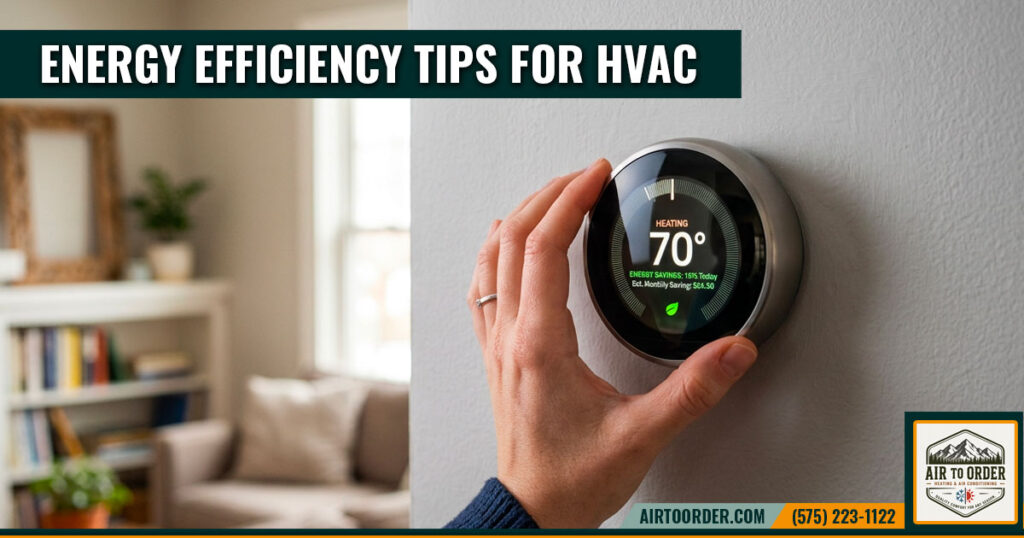
4. Install a Programmable or Smart Thermostat
Manually adjusting the temperature, or worse, leaving it constant all day, wastes energy when no one’s home or everyone’s asleep. A programmable or smart thermostat lets you:
- Automatically set back temperatures during work hours or overnight
- Create schedules tailored to your household’s routine
- Monitor energy usage trends over time
- Adjust settings remotely from a phone
Even modest setbacks of a few degrees for several hours a day can add up to noticeable savings over a year.
5. Improve Home Insulation and Air Sealing
Your HVAC system can only be as efficient as the building envelope around it. Gaps around windows, doors, and attic access points let conditioned air escape and outside air in, forcing your system to compensate constantly.
- Weatherstrip doors and windows
- Add or upgrade attic insulation
- Seal gaps around pipes, wiring, and vents
- Consider window treatments that reduce heat gain or loss
This is especially important in climates with large day-to-night temperature swings or long, cold winters, where heat loss through poorly insulated areas can outweigh gains from equipment upgrades alone.
6. Use Ceiling Fans and Zoning to Reduce System Load
Ceiling fans help distribute conditioned air more evenly, letting you set the thermostat a degree or two higher in summer or lower in winter (reversing fan direction) without sacrificing comfort. If your home has a zoned HVAC system, use it. There’s no reason to condition unoccupied rooms at the same level as living spaces.
7. Consider Upgrading to a High-Efficiency System
If your HVAC system is more than 10–15 years old, it’s likely operating well below the efficiency standards of newer equipment. High-efficiency furnaces, heat pumps, and air conditioners (rated by AFUE for heating or SEER2 for cooling) can cut energy consumption substantially compared to older units, even before accounting for wear-related inefficiency.
A licensed technician can assess whether repair or replacement makes more financial sense based on your system’s age, condition, and your home’s specific heating and cooling needs, including the altitude-related sizing factors covered in section 8.
8. Account for High-Altitude Performance
Homes in Angel Fire, Taos, Mora, and Cimarron typically sit between 8,000 and 10,000 feet, and that altitude changes how HVAC equipment actually performs, something most efficiency advice online doesn’t account for:
- Ask your technician to confirm your furnace’s gas input rate is derated for altitude. Furnaces installed above 2,000 feet need adjusted gas orifices or a reduced input rate to burn properly; a furnace set up for sea level will run inefficiently, or unsafely, at your elevation. This is a quick check during any tune-up.
- When replacing equipment, insist on altitude-specific sizing, not a flatland default. Thinner air reduces compressor and condenser heat transfer, so a heat pump or AC sized using standard manufacturer charts can under-perform once installed. Have your installer size it for your actual elevation.
- Put your efficiency dollars into heating, not cooling. Since mountain homes heat far more months than they cool, a better furnace or heat pump upgrade will save you more over a year than upgrading AC. Prioritize accordingly if you’re budgeting for a system replacement.
- Prioritize duct sealing and insulation before anything else. Large day-to-night temperature swings mean poorly sealed homes lose more ground here than in milder climates, so treat sections 3 and 5 above as higher-priority, not optional, at this elevation.
- Run a humidifier and set your thermostat a degree or two lower. Dry mountain air makes lower temperatures feel just as comfortable, and a humidifier lets you turn the heat down without sacrificing comfort.
If your equipment wasn’t installed or serviced by a technician familiar with high-altitude adjustments, it’s worth having that checked. It’s one of the most common efficiency gaps in mountain homes.
9. Don’t Ignore the Little Things
- Keep vents and registers unblocked by furniture or curtains
- Close the fireplace damper when not in use
- Use exhaust fans sparingly, since they pull conditioned air out of the home
- Shade south- and west-facing windows in summer to reduce cooling load
The Bottom Line
Energy efficiency isn’t about one big fix. It’s the combination of routine maintenance, smart controls, a well-sealed home, and equipment that’s right for your space. Start with the low-cost habits (filters, thermostat settings, sealing obvious gaps), then talk to a licensed technician about whether your ductwork, insulation, or aging equipment is holding your system back.
Noticing uneven temperatures, rising bills, or a system that runs longer than it used to? Those are usually signs your HVAC system is losing efficiency somewhere, whether it’s a dirty filter, leaky ducts, or equipment that’s simply worn out.
Air to Order is a veteran-owned, family-operated HVAC company based in Angel Fire, serving Taos, Mora, Cimarron, and the surrounding mountain communities. We’ll diagnose the issue honestly and tell you straight whether it’s a quick fix or time to start thinking about replacement.
Call (575) 223-1122 or schedule a service call to get started.